How to Read a Street Art Piece: Symbols, Styles, and Signatures
You turn a corner and there it is: a figure three storeys tall, half-finished, half-peeling, watching the traffic. Most people take a photo and keep walking. That's fine — but the piece rewards a slower look. Street art is a conversation with a place, and like any conversation it has grammar: recurring symbols, a handful of visual habits, and almost always a name tucked somewhere near the edge.
You don't need an art history degree to follow it. You need five minutes and a few questions to ask of the wall in front of you.
Read the Wall Before the Paint
Start with context. A mural on a school wall, painted over three weekends with scaffolding and a permit, is a different object from a tag thrown up at two in the morning under a bridge. Neither is better, but they ask different things of you: the first is usually a designed image with a message the artist expects you to get; the second is often about presence, speed and territory.
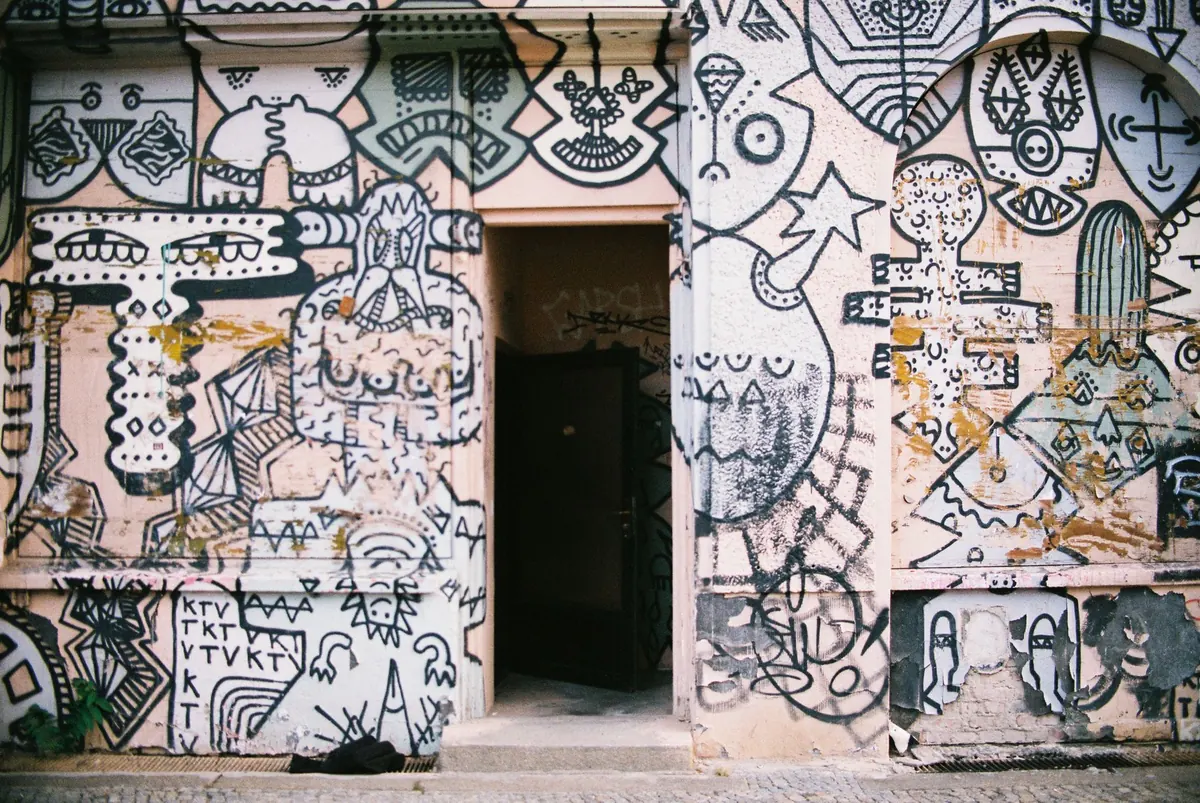
Ask what the surface has been through. Has the wall been buffed — painted over in flat gray or cream by the owner? Is the piece sitting on top of older layers, so fragments of previous work show at the edges? Are there fresh tags scrawled across the image? A mural crossed by other people's marks usually signals time passing and a spot everyone uses; it doesn't mean the piece is disrespected so much as shared.
Location matters too. Some walls are recognized practice spots where writers paint at leisure; others are high-visibility surfaces where getting the work up at all is the point. The street tells you how the piece is meant to be seen: glanced at from a bus, studied on foot, or photographed from the opposite pavement.
Know the Medium, and the Style Follows
Most confusion about street art dissolves once you know what the paint actually is. Medium shapes style more than any personal taste.
- Tags and throw-ups. Quick, letter-based marks made with markers, spray cans or the occasional fire extinguisher. A tag is a signature; a throw-up is a fast two-color bubble or block version of a name.
- Pieces and murals. Larger, planned works with outlines, fills and a background. Rollers and brushes mean hours on the wall; fine spray detail implies a stencil or a very steady hand.
- Stencils. Cut from card, acetate or Mylar. Look for hard, crisp edges, flat blocks of one color, and thin bridges of uncut material holding the shapes together. Small misalignments where two color layers nearly meet are a giveaway.
- Wheatpaste and paper. Printed or painted on paper and glued up. Edges wrinkle and tear; the paper yellows and lifts with rain.
- Stickers, mosaics and small objects. Invader's pixelated tile figures are the famous example, but the logic is broader: a durable, repeatable unit placed quickly in many places.
Once you can name the medium, you can guess the constraints. A stencil artist cares about contrast and silhouette; a spray-can muralist cares about gradients and blending. Both tell you where to look for craftsmanship.
Symbols: The Recurring Cast
Certain images turn up again and again across cities and decades. Knowing the family helps you read a piece even when you don't recognize the hand.
The usual suspects
Eyes, cameras and watches speak about surveillance and visibility — the city as a witness. Crowns and halos are about status, self-coronation and irony; a crown painted over a doorway is a boast as much as a joke. Hands offering, grabbing or pointing turn an abstract message into something physical. Birds carry freedom or messages; wolves, foxes and snakes often work as local totems. Skulls and masks handle mortality and anonymity. Doors, windows, cages and ladders are about passage and confinement. Hearts, flowers and children's imagery are tenderness used as a counterweight to concrete.
When a symbol is really a logo
Some recurring figures are less archetype than trademark. Keith Haring's radiant baby, Shepard Fairey's OBEY Giant, Os Gemeos' yellow-skinned characters, Invader's mosaics: a repeated character lets an artist be recognized from a moving car. When you spot the same figure three times in one neighborhood, assume you're looking at a campaign rather than a one-off, and start looking for the rest of it.
Meaning stays local
A crown in one city may carry a political jab; in another it's a crew emblem. Before deciding what an image means, ask what it is doing in this spot — opposite a bank, above a school gate, facing a police station. Placement is half the sentence.
Line, Color, Scale: Style Clues You Can Trust
Style is easier to describe than to define, but a few features travel well.
- Line quality. Confident single passes read differently from sketchy multi-strokes. Wobbles can mean speed, inexperience, or a deliberate hand-drawn look — check the rest of the piece before deciding which.
- Palette. Two or three colors usually mean fast, repeatable work. Wide palettes suggest time and a budget for materials.
- Scale and placement. Rooftop and upper-storey works are composed for distance and for people who can't get close. Eye-level pieces are built for detail.
- Finish. Tape lines, overspray, drips and clean buffed edges all record process. A perfect edge on a straight line often means masking tape.
- Use of the architecture. Does the image wrap a pipe, sit inside a window recess, or follow a crack? Site-specific work treats the wall as material, not canvas.
Signatures, Crews, and the Quiet Marks
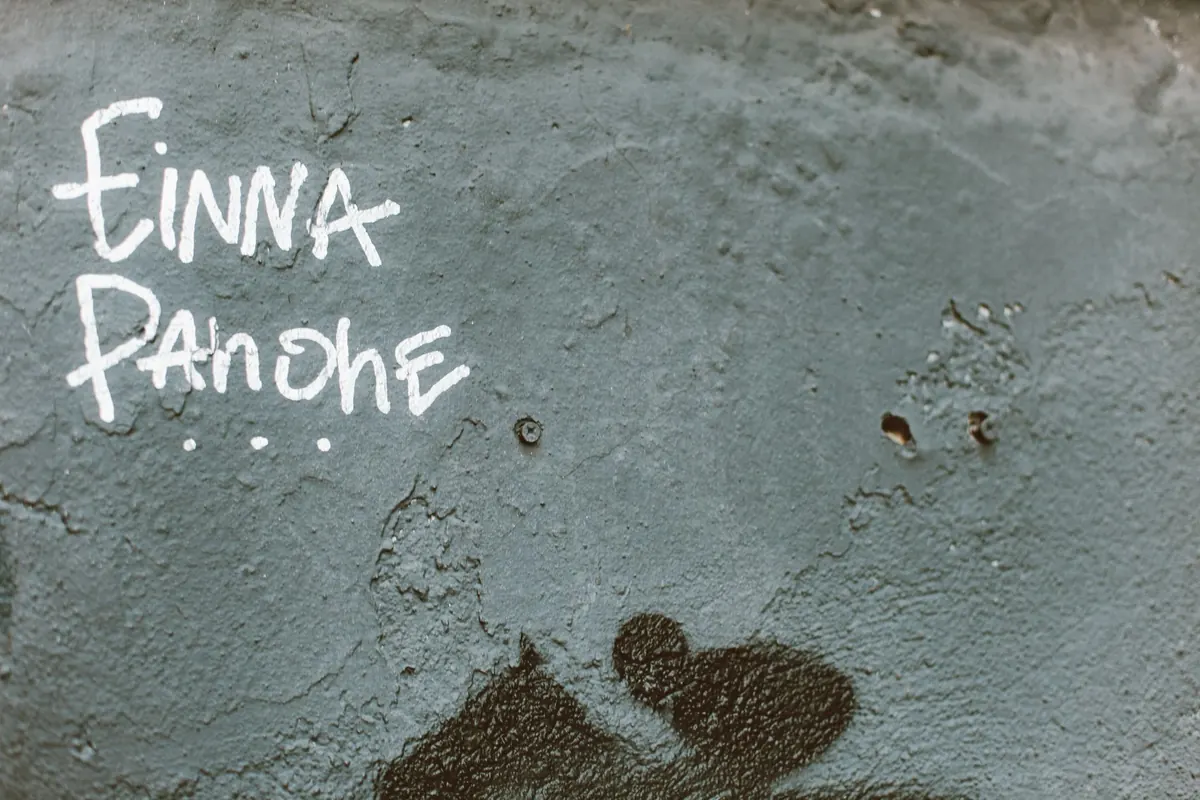
Almost every piece carries a name, rarely where you'd expect. Check the lower right corner, along the bottom edge, inside the fill of a letter, on the adjacent utility box, or on the wall behind the scaffolding. Signatures come as tags, crew initials, monikers, small drawn logos, rubber stamps and stickers.
The useful skill is telling the artist's own mark from later additions. A tag in the same paint and the same hand as the outline belongs to the piece; a thin marker scrawl across someone's face was added afterwards, often years later. Ask whether the mark sits inside the composition or on top of it, whether the color matches, whether it respects the image or ignores it.
Some artists sign with an absence. A completely unsigned piece in a spot known for one particular hand is itself information. So is a signature that appears only in the documentation — many artists photograph their own work and post it, which is often the fastest way to confirm an attribution.
Try This on Your Next Walk
Reading street art is a habit you build, not a test you pass. Next time a wall stops you, run this sequence:
- Shoot wide, then close. One photo of the whole piece in its setting, one of the details, one of each edge.
- Name the medium out loud. Spray, stencil, roller, paste, tile, sticker. Everything else follows from that.
- Find the signature before you leave. Corners first, then the surrounding street furniture.
- Write down three details — a color, a symbol, a placement decision. Three is enough to remember a piece for years.
- Check the neighbors. Walk two streets in each direction. Repetition is how you separate a one-off from a body of work.
- Go back. Pieces change, get tagged, get buffed. A second visit teaches you more than a hundred photographs online.
And keep your hands off the wall. Don't peel the paste-up, don't pick at the mosaic, don't climb the fence for a better angle. The work is doing its job in public, for free. Looking closely is the whole transaction.
Photo: Aliaksei Lepik / Pexels